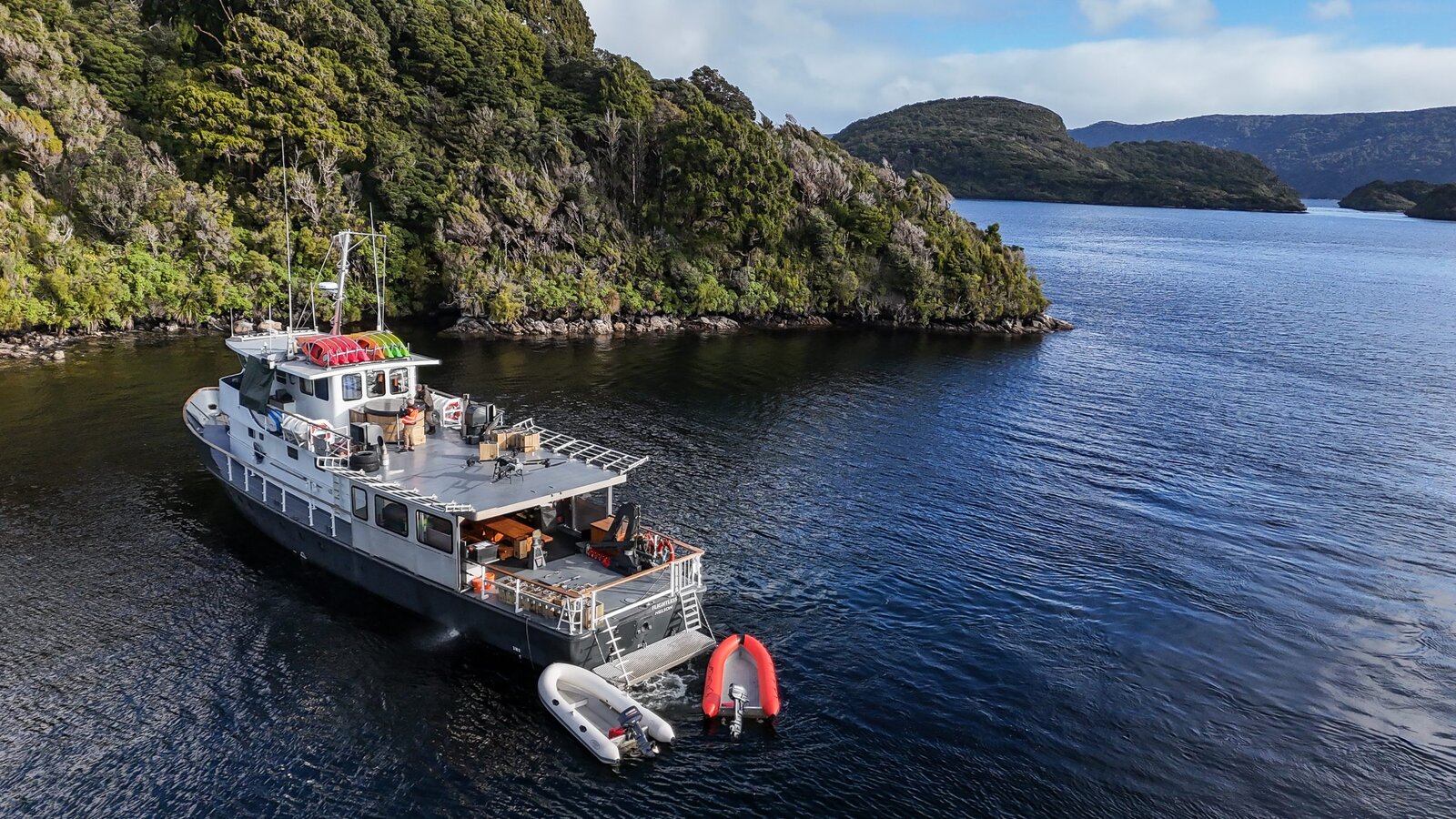
Pure Salt is helping to restore Tamatea Dusky, one boat trip at a time.
The trip’s going to be chilly. There’s a dump of fresh snow to low levels on the Fiordland Mountains. One by one, the volunteers turn up at the Manapouri hangar. It’s a motley lot, myself included. There are back-slaps and hugs – old friends now, we’ve shared time in the bush or on the boat, yacking over a table, ribs sore from laughter. We’ll come back to those good folk later.
With the weather forecast to deteriorate further, the flight has been brought forward. We fly down the South Arm of Lake Manapouri, up and over Emerald Pass – pure white today – then descend into Shark Cove at the inland extremity of Tamatea Dusky Sound. Magnificent. The machine lands gently on the top deck of Flightless. Waiting to usher us out safely and into the wheelhouse is Seán Ellis. His partner in life and business, Maria Kuster, is down below on the back deck, handing up the last of the luggage from the previous charter and saying goodbye to clients, a seamless transition between trips.
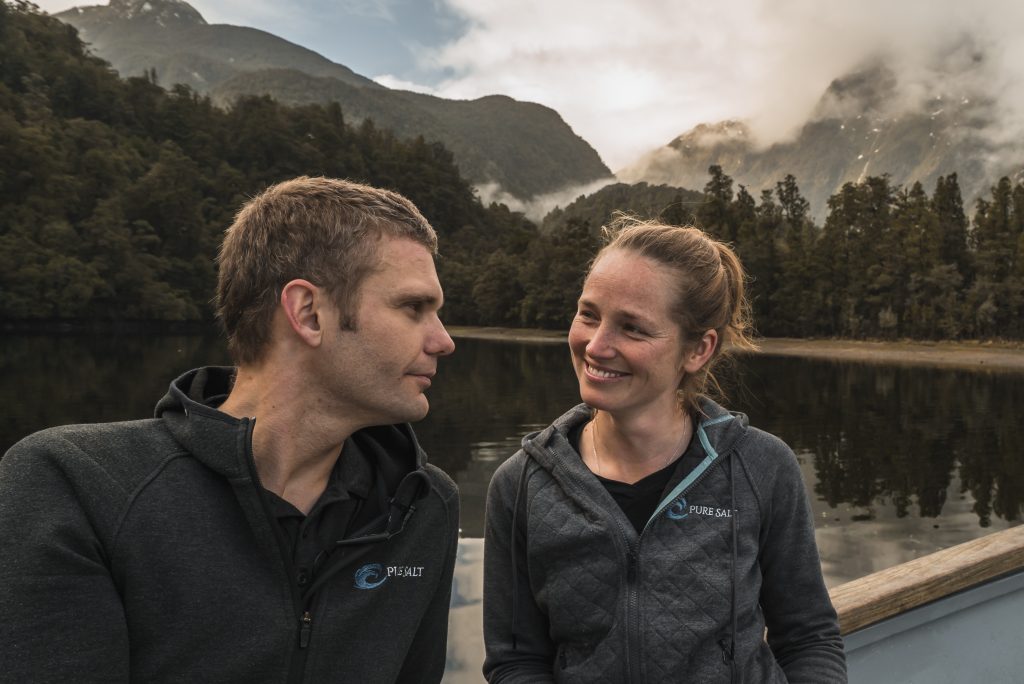
As the helicopter takes off again, a relative quiet descends and it’s safe to take a few steps onto the back deck and look around. Hello Dusky. Tamatea. Old friend. How lucky am I. I’ve spent a fair amount of time in this fiord (wrote a book about the place) and have been privileged to have been invited back time and again by Maria and Seán. They are the duo behind Pure Salt, a charter boat operation and the force majeure in some of the pest eradication and conservation projects in Tamatea Dusky, the 40-kilometre-long fiord in the southwest corner of Fiordland National Park.
We’re here early enough to put in a decent half day’s work before the short mid-winter day ends. Maria has already divvied up the tasks. Maps, GPSs and radios are handed out as the Flightless begins steaming down the 20-plus kilometres to Mamaku / Indian Island. We’re already counting lures, gas cannisters or tracking tunnel cards, stuffing all we need into packs and bumbags. It’s cold and raining. We’ll need a few layers. First though, there’s lunch. Oh, the food: that’s over to one of the “gorgeous humans” (as Maria calls us) who are volunteering for this week – the chef, Chris Smith, who serves his phenomenal cuisine to the crew of 16. Chris works on several paid charters, but he donates his time to the conservation trips. “I love it. You meet givers, not takers,” he says.
We need your help
READ MORE
This story is not a PR exercise. What these guys have undertaken is not ecological point scoring in the name of marketing. It’s hard work, very expensive, often daunting, and takes phenomenal vision. The next five days is one of several charters every year when Maria and Seán dedicate themselves (and not insignificant resources) to conservation in Tamatea.
I was here on Mamaku with them for the first time in late 2018, mid-summer. The days were long and hot. It was a magic week of following GPS lines, bush-bashing through scrub with flagging tape and then trailing behind chainsaws, cutting some of the many traplines on the island. Its English name, Indian Island, dates to March 1773, when Captain James Cook first arrived in Fiordland and encountered a Māori family on the island. A good number of Norway rats (Rattus norvegicus) arrived with him and scarpered off the HMS Resolution. The charts that Cook drew up and had copied in Greenwich, England, opened the floodgates and brought more hitchhikers in the hulls of sealing and whaling ships, including the now-common ship rat (Rattus rattus). Other mammalian pests, like stoats (the main predator of juvenile kiwi in the region), followed. Now, without intervention, only 5% of kiwi hatched in the wild survive to adulthood. Every trapline, every marker, every camera, all of it, is pushing back against more than two centuries of predation.
It’s raining hard as we climb into the dinghy. Darren Peters is in shorts. He started out in the Wildlife Service in the early 1980s when, obviously, they built them tough. Darren did his time with the Department of Conservation (DOC) creating and refining humane and efficient stoat and rat trap methodology; he happily drops everything to head south and volunteer here in Dusky. Lindsay Wilson was DOC’s principal ranger of biodiversity in Fiordland for several years and similarly says “yes” whenever Maria reaches out. Gavin Sinclair, a retired vet, is another regular, his fitness belying his age. Maria drops Lindsay, Gavin and Darren at various points on the southern side of the island to cover a couple of traplines, replenishing bait and resetting traps. I’m last, stepping out gingerly onto slippery rocks. I look for the barnacles for boots to cling to before edging up the bank, grasping whatever seedlings are well-rooted, up and onto the marked line to put out 30 tracking tunnels (a splodge of peanut butter on a card, inked with black, will show if any rodents are about) and retrieve SD cards and batteries from the trail cameras. Even walking uphill, I shiver in the almost-sleet.
Like many good stories, this story began with a connection. A glance across a crowded room, the old Milford Sound pub in fact, between two souls with a love of the ocean. Seán, brought up in the Marlborough Sounds, started with fishing, then a skipper’s ticket; Maria, born and raised in East Germany, reneged on university expectations and instead found her way to Fiordland, also gaining a skipper’s and engineering ticket.
They worked together on Fiordland charter boat and dive operations, both acquiring commercial dive certifications. The latter is important. When they bought and refurbished an ex-naval vessel to start Pure Salt, everyone wondered who their financial backers were. “You wouldn’t believe who backed us, according to all the stories,” Seán recalls. “But nope, just us. We were commercial diving on all the South Island dams, fitting, running cranes and working on Meridian projects. Diving is good money. We lived in a house bus. There was a time there when we didn’t have a day off for the best part of a year. That’s how we paid for Flightless.”
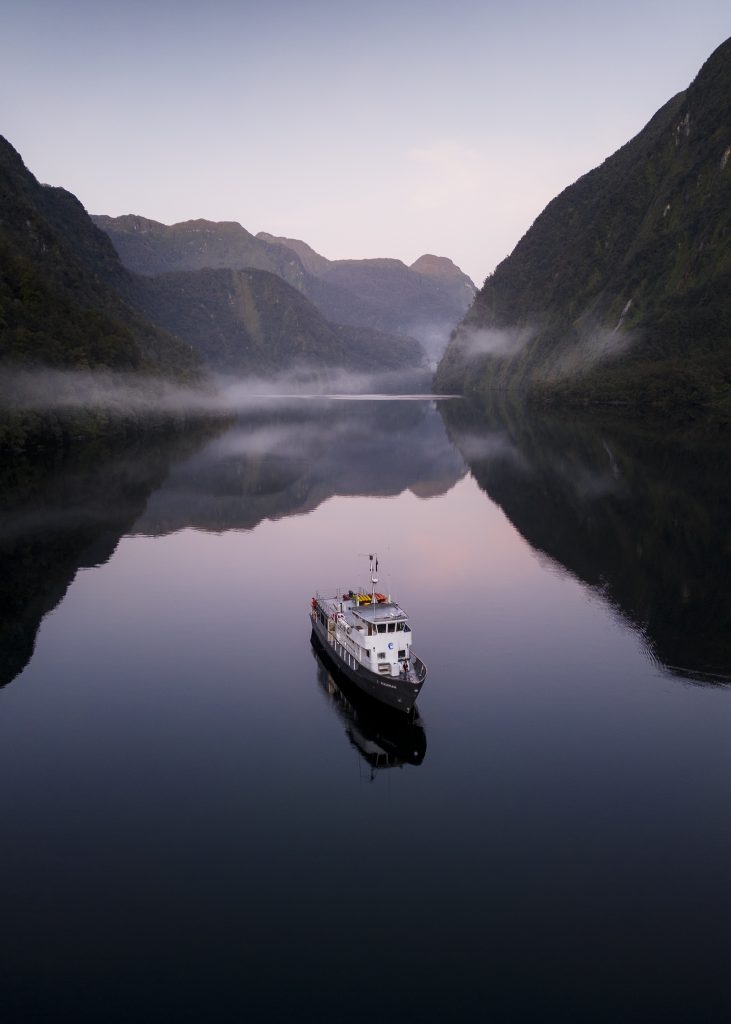
Pure Salt began as a full-time charter operation in Tamatea Dusky in 2017. From the start, Seán and Maria committed a significant slice of their time, attention and profits to the restoration of the place. “Blue conservation”, focused on the ocean, was front of mind at first. Aghast at how many charter boats were encouraging guests to fly out with their maximum daily recreational quota, the pair had watched target species – hapuku / groper and blue cod – decline in just a few years. They were determined to set an example on Flightless: fish for a feed, for the table only. In the first year of operation, they also instigated the now-annual TamateaBLUE Adventure underwater cleanup events. They retrieved two tonnes of underwater rubbish out of Luncheon Cove alone. As well, Pure Salt has contributed to the battle against the foreign pest seaweed Undaria pinnatifida, and flying out as we flew in on this trip was a NZ Geographic team who had been travelling with them to document the population of hapuku in the marine reserve of Wet Jacket Sound (it was snowing as the photographers came up from their dives).
From the ocean to the land. Not only is Tamatea Dusky Sound huge, it’s part of a greater archipelago with more than 700 islands. The conservation task is daunting, and more than a government department like DOC can manage alone. Late winter 2018, Maria met Lindsay (who was still with DOC at the time) for a coffee in Te Anau. According to Maria, “Lindsay brought a chart, and we sat down and went, ‘What do you need a hand with?’” He was gobsmacked. “I remember just being blown away by their sheer energy and motivation. Most companies might take on a few traps. But to take on one entire island is amazing. And to go beyond that, mindblowing.”
The island was Mamaku. On the first trip after the meeting “we flagged a few lines on Mamaku, and put the coastal traps in. It was a trip with paying clients, and Rusty was one of those clients,” Maria says. Rusty Vercoe, sadly not on this winter trip, has been a mainstay throughout. “There was so much energy on that first trip, we were saying, ‘Hey, we have to keep going.’”
Within eight months, 17 kilometres of traplines had been lightly cut on the 168-hectare island, and more than 300 traps installed. In less than a year, Pure Salt also started in on neighbouring Long Island (which, at more than 2000 hectares, is very long and very big). The milestones continued. Eighteen months out, rat tracking showed rodent numbers on Mamaku down to below 5% of previous totals, and kiwi (Fiordland tokoeka) appeared on the motion capture cameras. Pure Salt expanded the work. Pickersgill Harbour, Taumoana / Five Fingers Peninsula, Pigeon Island – the lineup of islands and mainland sites has accumulated.
Meanwhile, DOC concentrates on areas like Mauīkatau / Resolution Island and predator-free Pukunui / Anchor, where critically endangered kākāpō, among other threatened species, reside. When I began writing my book Tamatea Dusky, DOC’s aim was for all islands to be predator controlled, if not predator free, by 2025, particularly here in this archipelago. Sadly, that’s still a work in progress. Pure Salt is doing what they can to fill in a good many gaps, and to innovate in a way that is hugely instructive not just for DOC but for predator control and restoration projects accross the country.
After seven years’ work on Mamaku, there is now zero detection of rats. Tracking cards: nil footprints. None. Stoat numbers are similarly down. Viewing the SD cards is affecting – not just more sightings of kiwi, but pairs and even better, chicks. Big chicks, meaning the offspring are making it through the first six months, the danger period for predation. One volunteer, David Cary, has analysed sound recordings from across the island: a chorus of kiwi calls, single voices and duets of pairs calling to one another (gives you goosebumps, just listening), as well as rich birdsong from kākā, kākāriki and kakaruai.
Some might frame all this as “lawn mowing”. The islands are within rat- and stoat-swimming distance from the mainland, and reinvasion is a constant. But Maria smiles. Pure Salt is not simply counting dead animals; their work is reaching a whole other level through ongoing learning, and trial and error, on control practices and technology. “It’s always about three things,” Maria explains, “detection, attraction and dispatch.” The sound recorders not only detect birds. Higher frequencies can pick up bats and, potentially, rats, and a PhD student is currently developing an AI-based way of picking up these signals. On Taumoana / Five Fingers, the team (led by Rusty Vercoe) have worked on the placement of lures and cameras. Maria explains: “We tried not placing them on the grid pattern, as has been gold standard, but using local knowledge of valleys, ridgelines, waterways, natural game trails. Our detection rate soared four to five times.” Attraction? “We’re experimenting with sound lures, from rats to stoat litter noises, to crickets. Have tried kiwi calling as well.” And Pure Salt have just successfully used a drone to move 200 traps from Flightless onto Pigeon Island (as well as lunch via Uber Eats, and a bottle of whiskey, just ‘cos), saving both back-breaking human time and helicopter hours, the first operation of its kind in Aotearoa.
Such is the respect this team is garnering among DOC, Landcare and organisations like Zero Invasive Predators (ZIP), which is leading the Predator Free South Westland initiative, that Maria, Seán and Rusty are being invited to the top table. Maria is generous in her response: “We’re there, on the ground. We get to learn and are more than happy to share, because many don’t have the time or resources. The fact that we can see ecosystem changes in our lifetime is amazing. In less than a decade. I mean if we were to say, ‘Let’s see what happens in a hundred years from now?’ Imagine.”
But how do they do it? Seán: “Our accountant thinks we’re nuts. If we didn’t do the conservation work, we’d have a house by now.” Actually, they do have a house, a 6×6-metre one. It’s not unlike the house bus. They also have a decent shed for all the equipment. Even so, this is a Robin Hood operation. This week’s trip has three paying guests (they came because of the conservation focus), and every other charter offsets the costs of the conservation trips. Seán again: “We haven’t got kids. We’re just happy pouring it into the place. It’s our home here, after all.” The work is all encompassing. There’s also ‘TamateaART’, for which artists invited are onboard, often then donating their work to raise funds for the conservation work. And Seán and Maria have now bought the sister ship to Flightless, Waka Kura, which is currently undergoing an extensive refit in Picton. Another charter boat? Seán grins. There’s talk about it as a research vessel, of support to conservation work in the Subantarctic, the South Pacific, and as another means of giving back at home.
At the beginning and end of every Dusky trip there’s a group meeting. At the outset, there are introductions. Most of us know one another, and it’s typically a self-deprecating series of bad jokes. But at the end of every trip, the tone changes. This participant admits to fighting back tears, regularly. You can’t help but be humbled and – yes – inspired, by the people at the heart of this endeavour. Gorgeous humans, indeed.
Peta Carey
